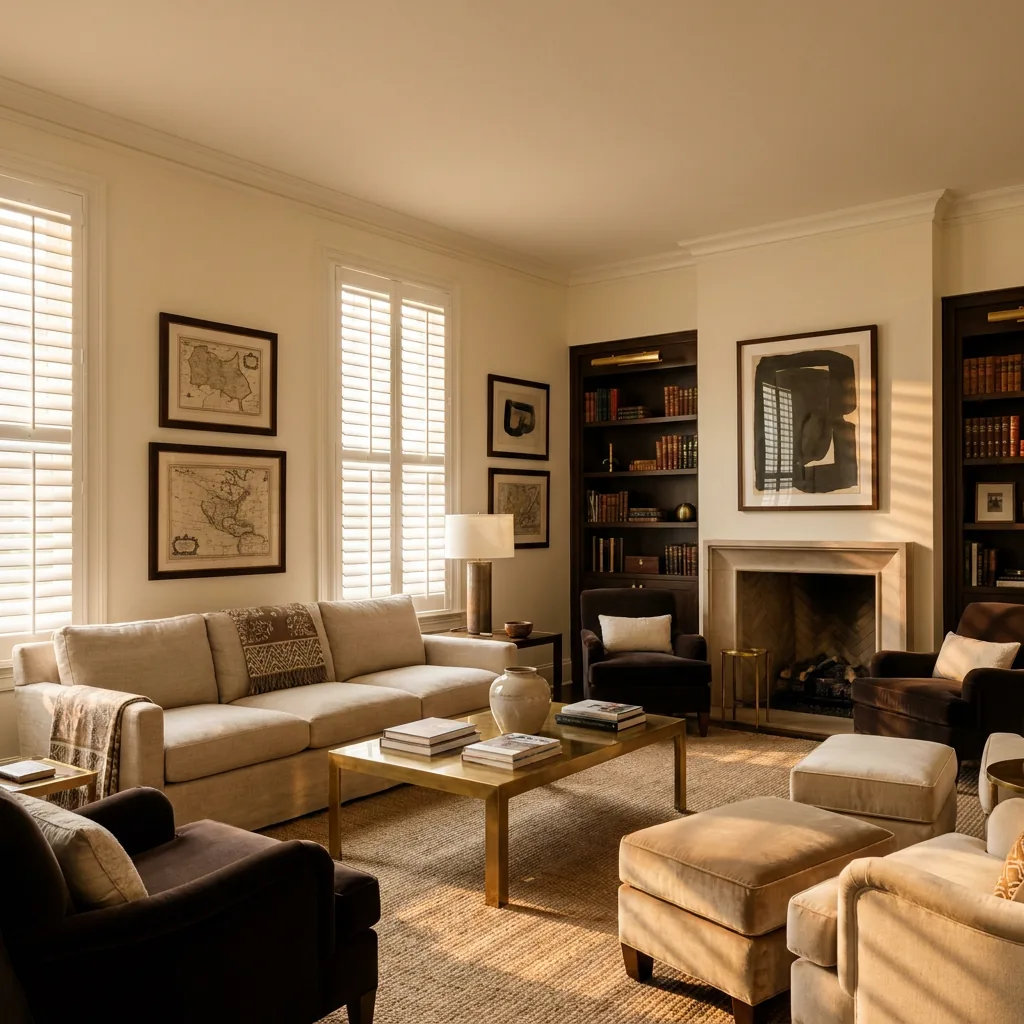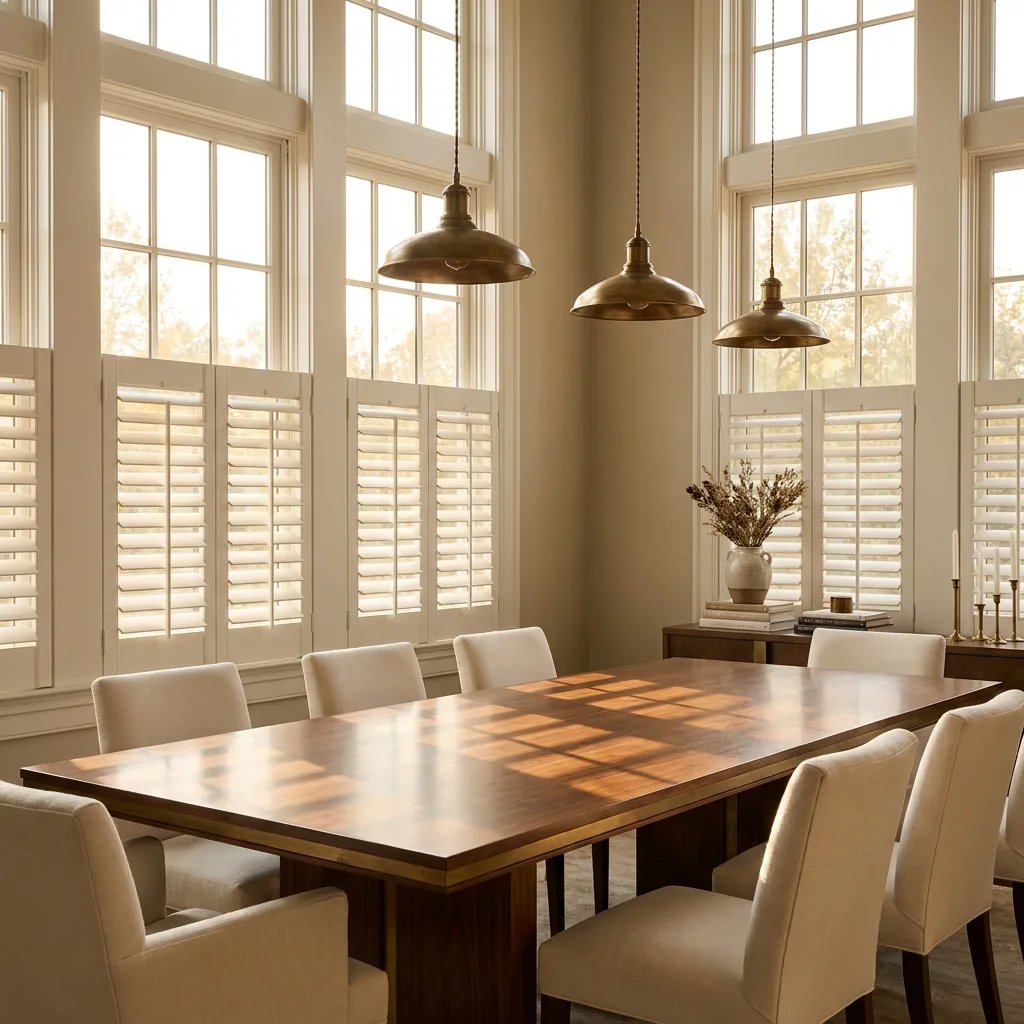
Plantation shutters are the most permanent window treatment in residential architecture. They are not covering a window — they are part of it. Done well, they will outlast every other surface in the room they were installed in. Done poorly, they are a costly mistake. This is the complete guide to what plantation shutters are, what they are made of, and what to expect when you order them for a Tennessee home.
What plantation shutters are
A plantation shutter is a hinged panel of horizontal louvers, mounted on a frame inside or outside the window casing. The louvers tilt — usually 90 degrees of travel — to control light and privacy. The panels themselves swing open on hinges, like cabinet doors, when full access to the glass is needed for cleaning or airflow.
The name plantation comes from the antebellum south — the original wide-louver shutters were sized for ventilation in pre-air-conditioning homes. The modern product is the same form factor with five decades of refinements: hidden tilt rods, tighter manufacturing tolerances, dust-resistant finishes, and now silent motorized tilt.
The three materials
Basswood (premium hardwood)
The industry standard for hardwood shutters. Lightweight, dimensionally stable, and accepts paint and stain better than any other wood used in the category. Norman Heritance and Hunter Douglas NewStyle are the two basswood lines we install most. Expect a 25-year service life with normal use, longer with light handling.
Best for: living rooms, dining rooms, primary bedrooms, formal spaces, and any window where the shutter is meant to read as architecture.
Composite (faux wood / poly-resin)
An engineered material — usually a polymer or wood-polymer hybrid — molded to the same dimensions as basswood. Performs identically to hardwood for light and privacy, with two big differences: it costs about half as much, and it is immune to moisture, warping, and finish failure. Hunter Douglas Palm Beach and Norman Woodlore are the lines we sell most.
Best for: bathrooms, kitchens, laundry rooms, mudrooms, and anywhere humidity, splash, or steam is in play.
Alder, oak, and specialty hardwoods
For rooms where stain — not paint — is the final finish, we sometimes spec alder, oak, or cherry. These show wood grain through the stain (basswood does not), so they read more rustic and warmer. Lead times are longer (4–6 weeks vs. 2–3 for basswood), and the cost premium is real (typically 30–60% over basswood). Worth it in a study, a library, or a home with stained trim throughout.
Louver sizes
Louver width controls how much of the glass you see when the shutters are open. The three standard sizes:
- 2.5″ louvers. The most traditional. Reads as classic, slightly historic. Right for cottages, craftsman homes, and bay windows where the proportions are smaller.
- 3.5″ louvers. The current default — what we install most in 2026. Shows more glass when open, more architectural. The best all-rounder.
- 4.5″ louvers. Modern, oversized, dramatic. Works on tall windows in great rooms with high ceilings; will overwhelm a small window.
A useful rule: louver width should be roughly proportional to the height of the window. Tall, generous windows can carry 4.5″. Small bath windows look right with 2.5″.
A shutter sized correctly disappears into the architecture. A shutter sized wrong shouts.
Frame styles
The frame is the piece that touches the wall and holds the panels. There are seven standard frames; two account for most installs:
- L-frame — the standard outside mount. Sits proud of the casing. Most common in homes built after 1990.
- Z-frame — wraps into a deeper opening for an inside mount. Used when the casing is at least 2.5″ deep and you want a clean recessed look.
Specialty options (deco, decora, bullnose, full-casing-return) add cost but solve specific architectural problems — French doors, casing that already returns to the drywall, very thin trim.
Tilt rods
The vertical rod that tilts the louvers can be visible or hidden. Hidden tilt (sometimes called clearview or concealed) is now the default on premium lines — the louvers move via an invisible mechanism in the stile, giving a clean, modern face. Front tilt rod (visible center rod) is the traditional look — appropriate on historic homes, sometimes preferred for symmetry.
Hinges and finish
Hinges come in painted, polished nickel, oil-rubbed bronze, satin brass, and matte black. Choose to match cabinet hardware in the kitchen, lever sets at the door, and faucetry in the bath. We bring physical samples to every consultation.
Finishes are factory-applied — multi-step, baked, durable. The standard paint palette runs about thirteen variations of white (creams, eggshells, soft greys). Custom color matches are available on most lines for a $80–$180 per window upcharge and 1–2 weeks of additional lead time.
Our standard 2026 spec
Norman Heritance basswood, 3.5″ louvers, L-frame outside mount, hidden tilt, satin brass hinges, painted in the trim color of the home. For wet rooms: Woodlore composite, same configuration. This combination accounts for over 70% of the shutters we installed in 2025.
Where plantation shutters go (and where they don't)
- Living rooms, dining rooms, sitting rooms. The natural home of the plantation shutter. Architecture and light all align.
- Primary bedrooms. Beautiful, but be aware: louvers always leak a little light at sunrise. We often pair shutters in the bedroom with a roman or roller shade for true blackout. More on bedroom blackout here.
- Bathrooms, kitchens, laundry. Composite, every time. The single most common product mismatch we re-quote is hardwood shutters in a bathroom.
- Bay windows and arched windows. Spectacular when done right. Templated, custom-fabricated, and worth every dollar.
- Sliding glass doors. Bypass-track plantation shutters exist, but are heavy, costly, and operate awkwardly. We usually recommend vertical privacy sheers (Luminette) instead.
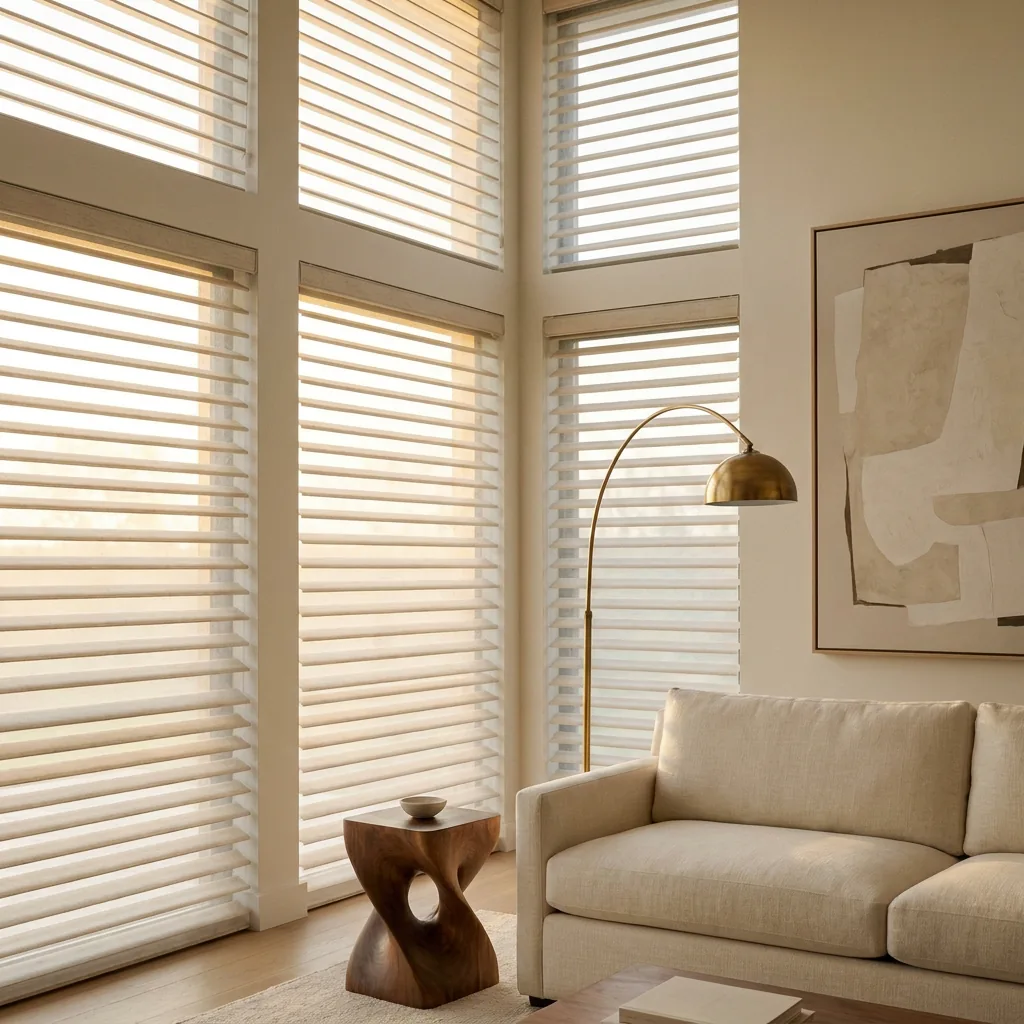
- Sunrooms, tall stairwells, atriums. Plantation shutters work, but motorized cellular or sheer shades are often a better match for the scale.
Motorization
Tilt-motors for plantation shutters are now available on most premium lines. Hunter Douglas PowerView Gen 3 drives tilt on NewStyle and Heritage; Norman has its own tilt motor on Heritance. Adds $200–$400 per window, plus a one-time hub. Worth it on atrium walls, primary suites, and any shutter you find yourself adjusting more than twice a day. More on motorized shades here.
How much they cost in Tennessee
Short version: composite runs $350–$700 per window installed; basswood runs $700–$1,500+ per window installed. Whole-house packages most often land between $5,500 and $14,000. For the line-by-line breakdown — including motorization upcharges, frame upgrades, and the install costs that brochures hide — see our plantation shutter cost guide for Tennessee.
What we install most often
- Norman Heritance — basswood, premium hardware, exceptional finish work. Our default hardwood line.
- Norman Woodlore Plus — composite, water-resistant, matches Heritance dimensions. Default wet-room line.
- Hunter Douglas NewStyle — hybrid construction, lifetime guarantee, motorized tilt available. Top of the catalogue.
- Hunter Douglas Palm Beach — polysatin composite, no-warp, washable. Top of the wet-room catalogue.
For an in-home consultation across Gallatin, Nashville, Hendersonville, Franklin, Brentwood, Murfreesboro, and the 90-mile radius around our Gallatin showroom, call or text 629-298-8241 or book a free visit. We bring louver samples, finish chips, hinge samples, and a written quote — all on the same trip.