A bedroom blind has a job description that almost no other window treatment shares. It has to make the room dark enough to sleep through a Tennessee summer sunrise, quiet enough that a 5 a.m. delivery truck does not pull you out of a dream, warm enough on a January morning that the window isn't the coldest surface in the house, and beautiful enough that you actually want to live with it. Most blinds do one or two of those well. A few do all four.
This is the short list we hand new clients when they ask. Five treatments, ranked by how often we install them in a primary bedroom in 2026, and what we'd put behind each one if cost weren't a factor.
1. Cellular (honeycomb) shades — our default recommendation
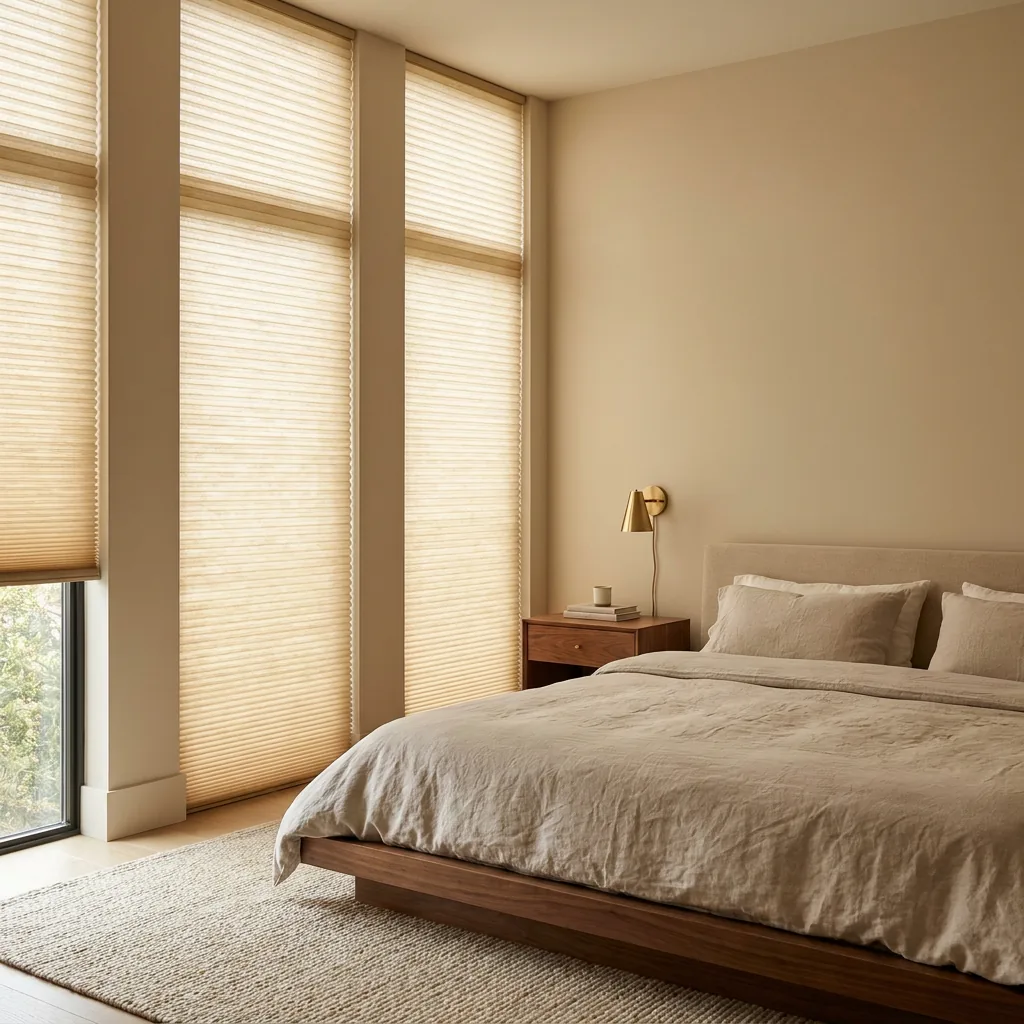
If you let us pick one product for every bedroom in a typical Tennessee home, we'd pick a top-down/bottom-up cellular shade with a blackout liner. Hunter Douglas Duette (Architella triple-cell, in the LightLock side channel) is the premium version. Norman Honeycomb and Hunter Douglas Sonnette are the lines we install most.
What makes them earn the top slot:
- Insulation. The honeycomb structure traps air. We measure 4–6°F differences between bedrooms with cellular shades and bedrooms with standard blinds during a Nashville August.
- Sound. The same cells dampen exterior noise — useful for any bedroom on the street side of the house.
- Light control range. Top-down/bottom-up means you can have privacy from the sidewalk and morning light from the sky at the same time.
- Blackout option. With LightLock side channels (or Norman's PerfectFit equivalent), they reach genuine darkness — not the leaky "room-darkening" half-measure.
Typical installed cost: $220–$520 per window; $320–$700 motorized.
2. Roller blackout shades layered with drapery
The treatment magazines photograph and clients ask for by name. A clean roller blackout shade (we mostly use Hunter Douglas Designer Roller and Norman Roller) sits flush at the top of the window. Behind, or in front, you hang a floor-to-ceiling drapery panel.
It is the most layered look on this list, and the easiest to make a bedroom feel finished. The trade-off is that to get to true blackout you need an outside-mount on the roller (or side-channel hardware), and to get the drape to read correctly you need it hung high — six to ten inches above the casing, never on the casing itself.
Typical installed cost: $180–$480 per window for the shade, plus drapery.
The most common bedroom mistake we fix: drapery hung on the casing instead of the ceiling. Hang it high. Always.
3. Plantation shutters
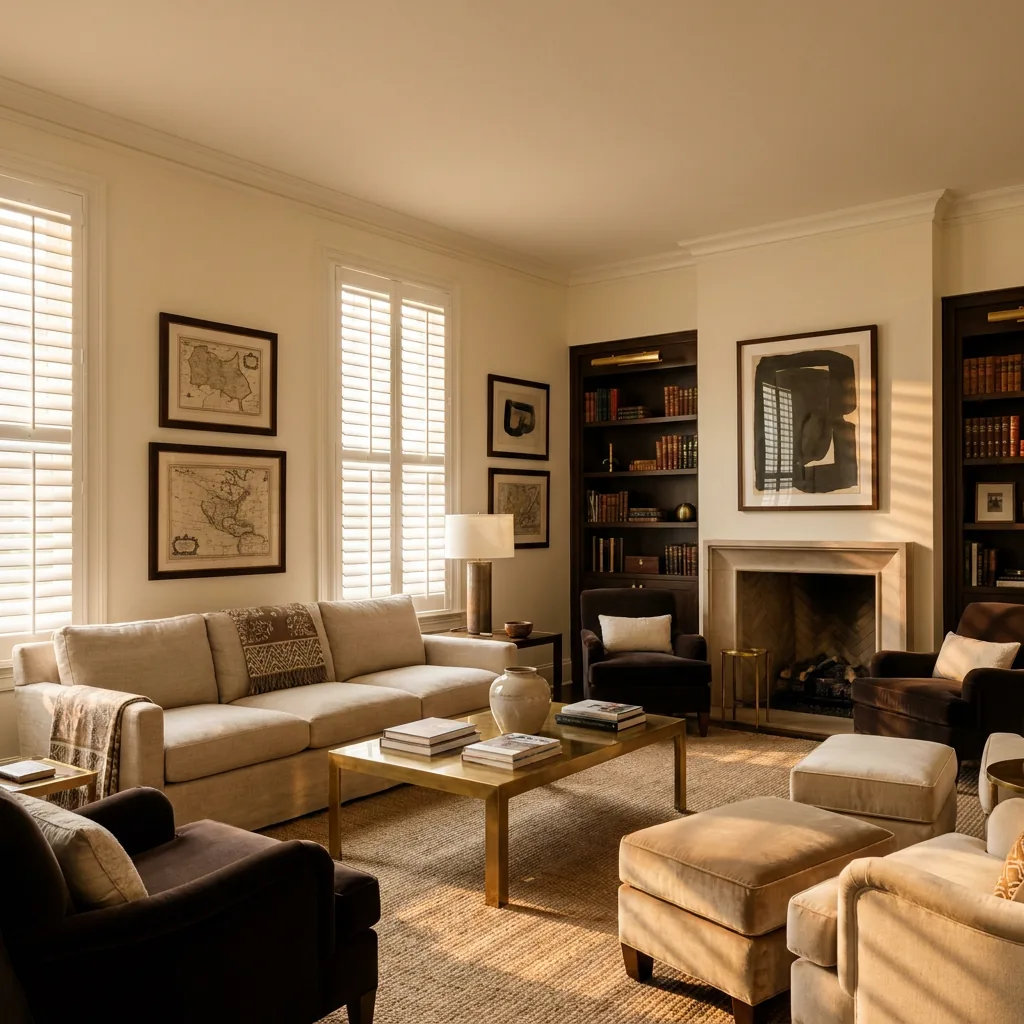
Shutters are not the first treatment we recommend in a primary bedroom — they don't blackout as well as cellular or roller, and the louvers always leak some light at sunrise. But in a guest bedroom, a child's room with a clean architectural look, or a primary that already has heavy drapery for darkness, plantation shutters earn their place.
The reason is permanence. Shutters convey with the house. They look correct from the street. And a child's bedroom with 3.5″ hardwood shutters and a single roman shade over the top of the window for blackout is one of the prettiest combinations in residential design. Pricing breakdown here.
4. Roman shades
Roman shades are the soft-fabric answer for a bedroom that wants more texture than a roller and more grace than a cellular. We sell them most in primary bedrooms with traditional architecture and in nurseries — fabric is forgiving, the fold reads warm, and the lift cord is now cordless on every line we sell (a child-safety standard since 2018, and one we never compromise on).
Pair with a blackout liner if the room needs darkness. A roman alone is room-darkening at best, not true blackout.
5. Motorized everything
Strictly speaking this is not a fifth product — it is an upgrade to the four above. But it deserves its own section because of how often it changes the answer to "which blind is right for my bedroom."
In a primary bedroom, motorization adds three things that are hard to live without once you've had them:
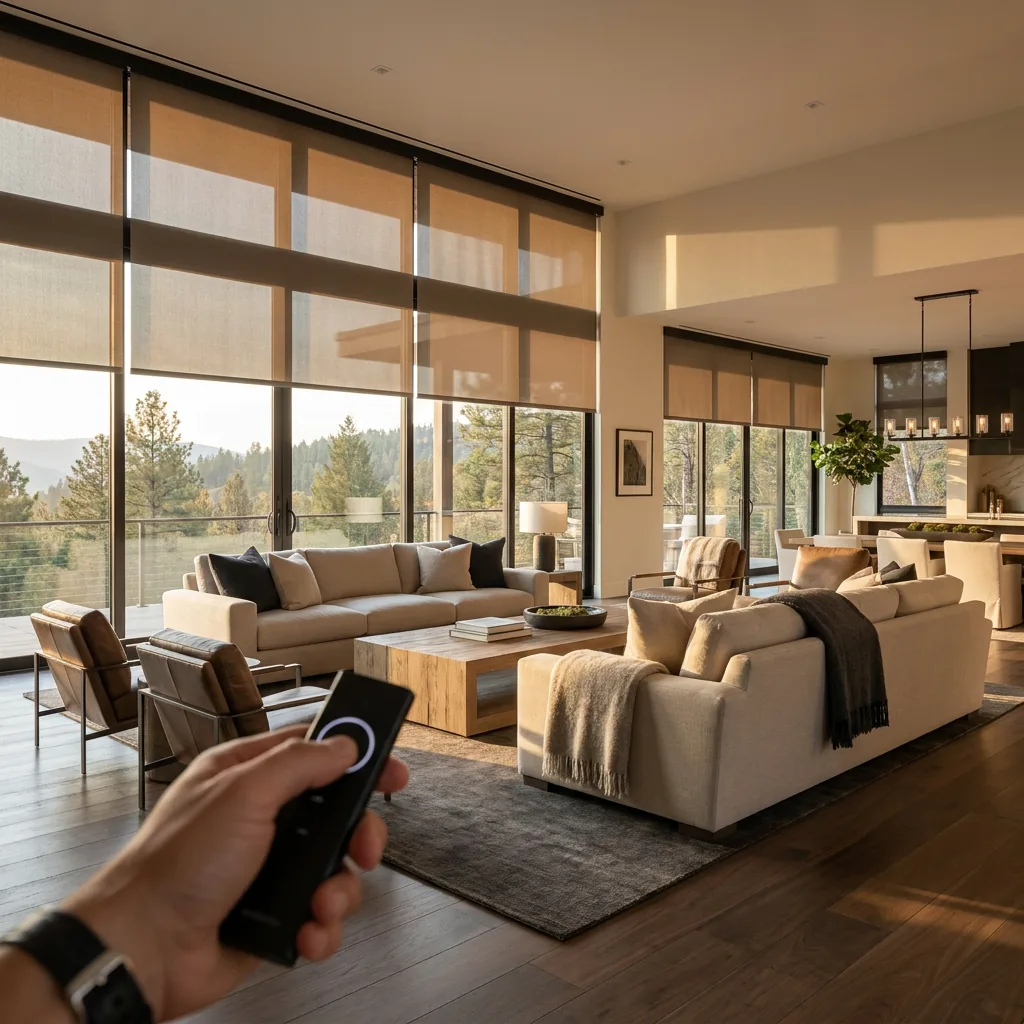
- Wake-up scenes. Set the blackout to slowly raise at 6:30 a.m. The room brightens by daylight, not by an alarm clock. The single most-loved feature of every smart-home install we've done.
- Bedtime, hands-free. "Hey Google, goodnight." Every blind in the room closes.
- The unreachable window. Primaries with vaulted ceilings, transoms over the bed, atrium glass — a motor turns a treatment from an annual call-the-pro chore into a daily, ten-second operation.
We work primarily with Hunter Douglas PowerView and Somfy — both integrate with Alexa, Google Home, and Apple HomeKit. Full motorization buyer's guide here.
Our 2026 default bedroom spec
For a typical Tennessee primary bedroom: motorized Hunter Douglas Duette cellular shade with LightLock blackout, layered behind a floor-to-ceiling sheer drape on a ceiling-mounted track. Quiet, dark, warm, and elegant — and it survives a 6 a.m. summer sun.
What about kids' rooms and nurseries?
Same answer, simpler product. Cordless cellular shades with blackout liner, every time. Cord-free is non-negotiable. We won't sell a corded shade for a child's room, even if asked.
For windows with cribs or beds underneath, we also pull the blind to within an inch of the sill rather than letting the bottom rail hang loose. Small detail, real safety improvement.
Mistakes we see most often
- Inside-mount blackout. Light always leaks around the edges of an inside-mount unless you add side channels. If darkness matters, mount outside.
- Drapery on the casing. The single most common mistake. Hang the rod 6–10 inches above the casing, and let the panels skim the floor.
- One product for every window. Bedrooms, bathrooms, and offices all want different things. A homeowner who picks one shade for the whole house usually under-serves at least one room.
- Cheaping out on the motor. Battery-only motorized shades that get used three times a day will need batteries replaced inside of nine months. For high-use windows, ask about hardwired or solar-charged options.
What we install in our own bedrooms
If it helps to know — our own Gallatin home runs cellular shades top-down/bottom-up in every bedroom, motorized in the primary with a wake-up scene, and 3.5″ hardwood plantation shutters in the formal living room. Bath windows are composite plantation shutters. That is the same recipe we recommend to most clients.
For an in-home consultation across Gallatin, Nashville, Hendersonville, Franklin, and the surrounding 90-mile radius, call or text 629-298-8241 or request a visit.