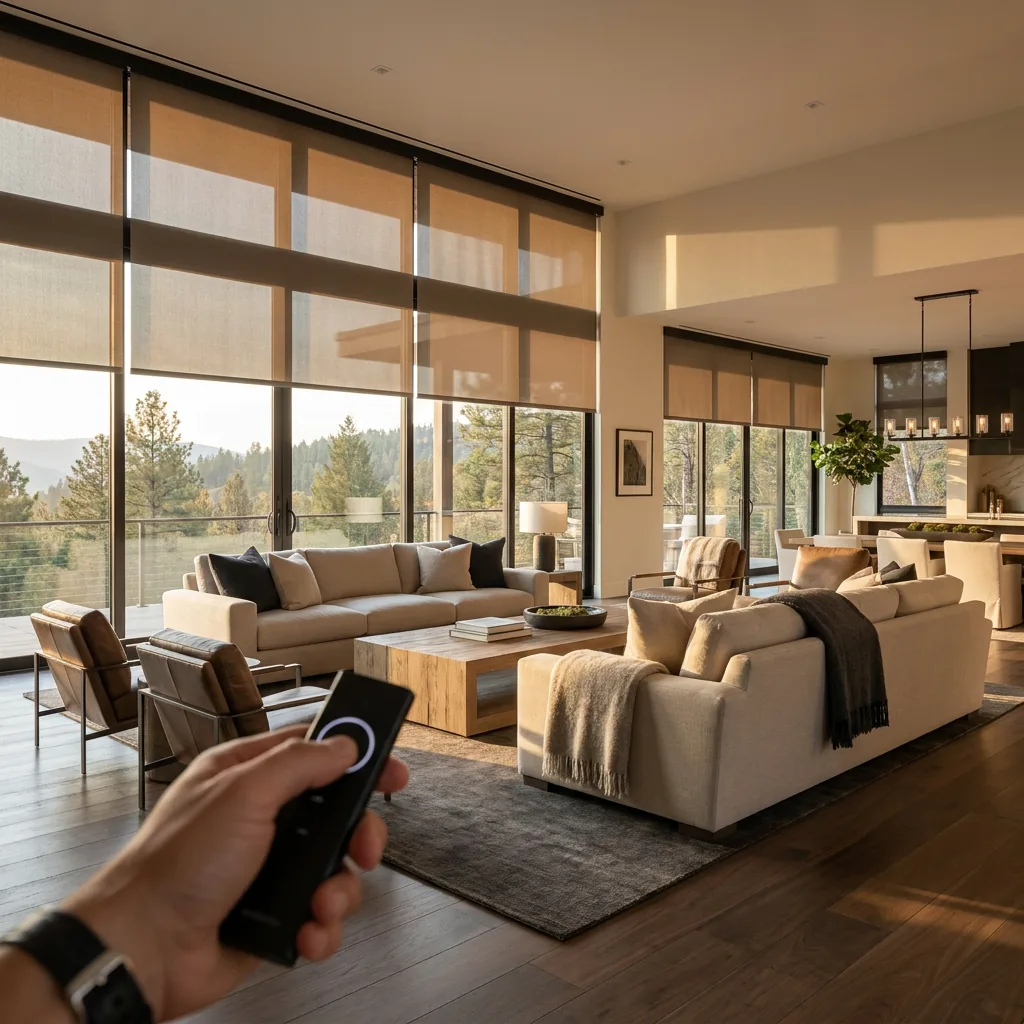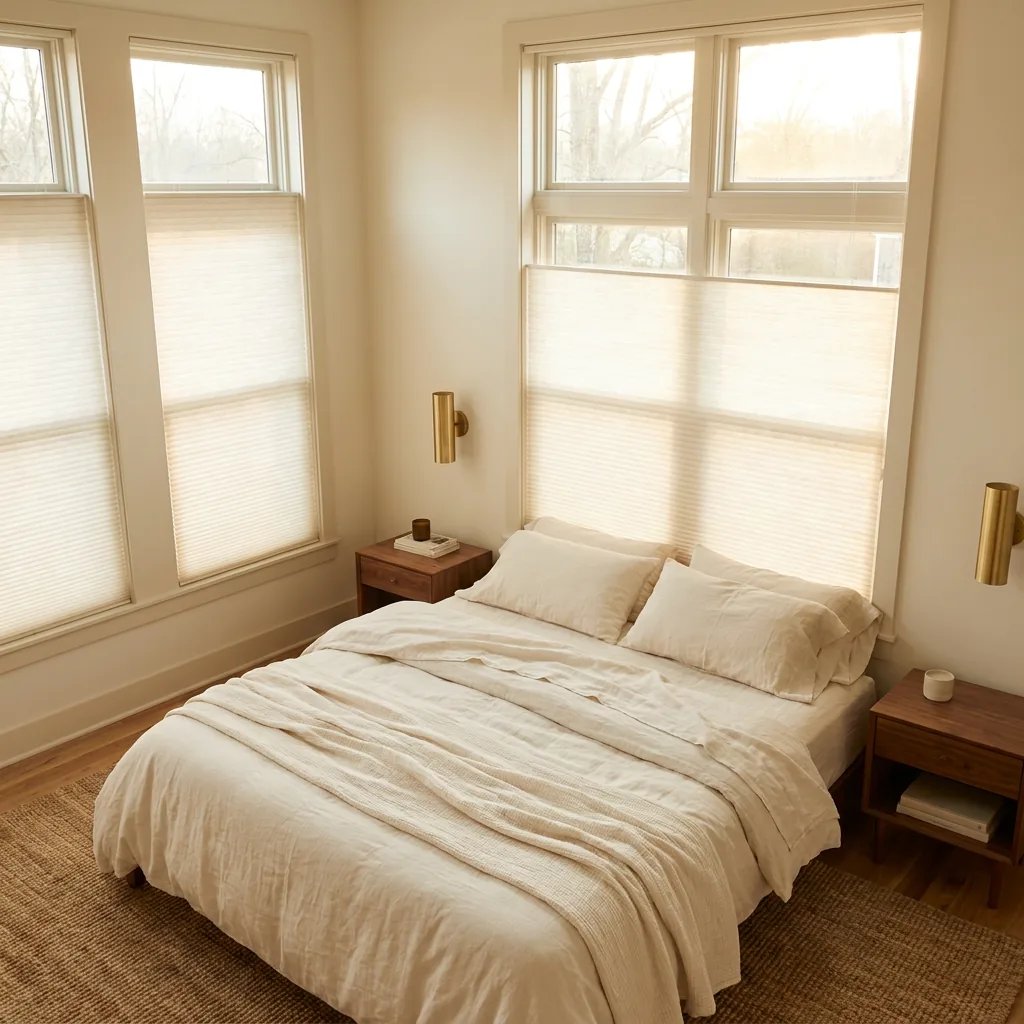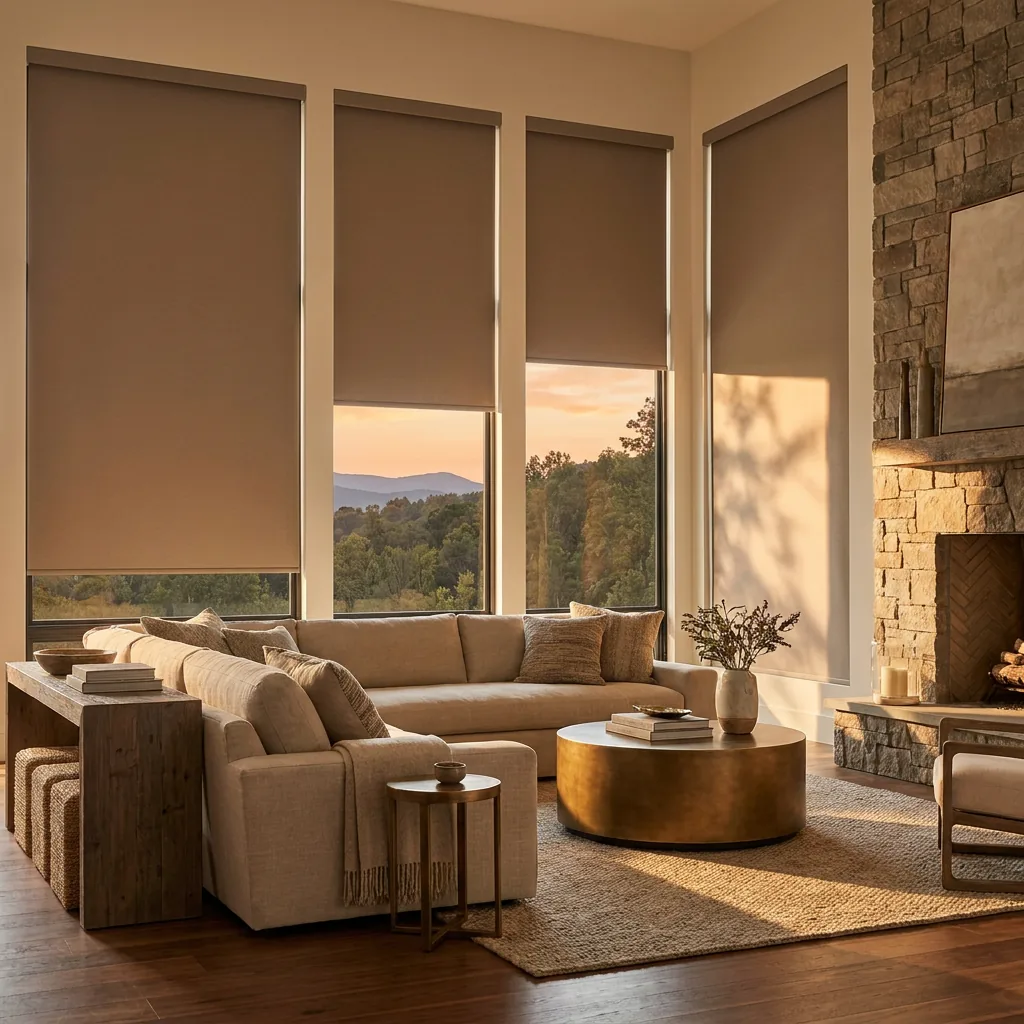
Motorization is no longer a luxury accessory — it is the default upgrade on roughly half the projects we quote in 2026. Battery wands clip on without an electrician. Hubs are the size of a deck of cards. Voice control with Alexa, Google Home, and Apple HomeKit now works on the first try. Here is the complete guide to motorized window treatments: every product type that can be motorized, every system we install, and the scenes that make it worth doing.
What can be motorized
Almost everything we sell. The current motorized catalogue includes:
- Motorized roller shades — the most popular, by a wide margin. Solar/UV-filter, light-filter, room-darkening, and blackout fabrics all available.
- Motorized cellular and honeycomb shades — Hunter Douglas Duette, Sonnette, Norman Honeycomb. Top-down/bottom-up motorization is supported.
- Motorized sheers and privacy vanes — Hunter Douglas Silhouette, Pirouette, Luminette.
- Motorized Roman shades — Hunter Douglas Vignette and most custom fabricators.
- Motorized woven wood — Hunter Douglas Provenance.
- Motorized horizontal blinds — wood, faux wood, and 2.5″ slat.
- Motorized drapery rods — Somfy Glydea, Lutron Sivoia, Hunter Douglas Designer Drapery Rod.
- Motorized plantation shutter tilt — louvers tilt by motor while panels still open by hand.
- Motorized outdoor shades and awnings — Sol-Lux, Somfy-driven retractable systems.
The three systems we install
Hunter Douglas PowerView Gen 3
The first-party motorization for every Hunter Douglas treatment. Gen 3 (released 2023) is dramatically faster and more reliable than Gen 2. Pebble Pro remote, mobile app, and native integration with Amazon Alexa, Google Home, Apple HomeKit, and SmartThings. The premium choice for projects centered on Hunter Douglas fabrics.
Somfy
The professional standard. Somfy motors live inside motorized treatments from Norman, Graber, Sol-Lux, and most major custom workrooms. The TaHoma hub controls scenes, schedules, and integrates with every major smart-home platform. Best for: mixed-brand projects, outdoor systems, and homes with security/automation already on a Somfy-friendly system.
Lutron
The right choice when the home already runs on Lutron — RA2 Select, Caseta, or RadioRA 3. Lutron's Sivoia QS shading line is the industry's quietest and longest-lived motorization, but cost is at the top of the category. We spec Lutron most often in homes where the lighting control is also Lutron and one keypad needs to drive both.
For 9 out of 10 retrofits, PowerView or Somfy is the right answer. Lutron earns its premium when the project is whole-home automation, not just shades.
Power options
Battery
Rechargeable lithium battery wand clips to the headrail. USB-C charge every 12–36 months. The retrofit default. No electrician, no wall work.
Hardwired
Low-voltage wiring to a centralized transformer. The new-construction default. Forever-on, instant response, supports the heaviest treatments (drapery, outdoor screens).
Solar
A small solar panel on the window casing trickle-charges the battery. Set and forget. Best on south-facing windows, tall stairwell glass, atriums.
Plug-in
Cord runs from the headrail to an outlet. Works, but the cord is visible. We mostly recommend this only when battery isn't viable (heavy drapery) and hardwired isn't possible (no in-wall access).
Our default 2026 spec
Existing home: battery. New construction: hardwired with a centralized transformer per floor. Tall stairwell glass that's hard to reach: solar. Drapery on a long track: plug-in or hardwired.
Voice control and smart-home integration
Every motorized shade we install in 2026 integrates with:
- Amazon Alexa — "Alexa, raise the living room shades."
- Google Home / Google Assistant — "Hey Google, goodnight."
- Apple HomeKit / Apple Home — Siri, scenes, and home automations.
- Samsung SmartThings
- Lutron RA2/RA3/Caseta when running on Lutron
- Control4 and other higher-end automation platforms via integrations
The single requirement: a hub, located somewhere in the house with power and Wi-Fi. The hub talks to the shades on a low-power radio and bridges everything to the network. We pick the location on the consultation visit.
Scenes — the feature you'll actually use
A scene is one command that moves multiple shades to predetermined positions. Voice control is the headline. Scenes are what change how you live in the house.
The scenes we set up in every motorization project:
- Good Morning. Primary bedroom blackout shades raise gradually starting at the alarm time. The room brightens by daylight, not by sound.
- Good Night. Every shade in the house lowers in one tap. Privacy, security, sleep prep.
- Movie. Family room shades drop to full blackout, hallway shades go halfway, kitchen stays up.
- Sun Block. Solar shades on the southwest exposure drop at noon in summer, raise at 6 p.m. Sun-tracking by astronomical clock.
- Vacation. Random shade movements throughout the day to simulate occupancy.
What it costs
Per-window motorization premium in 2026:
- Motorized roller shades — from $320/window installed
- Motorized cellular/honeycomb — from $380/window installed
- Motorized Silhouette, Pirouette, Luminette — from $600/window installed
- Motorized plantation shutter tilt — from $700/window installed
- Hub (one per house): $150–$300, one-time
- Hardwired transformer + electrician: $400–$1,200 per room
For the full smart-home buyer's perspective — PowerView vs. Somfy decision tree, battery vs. hardwired math, and the rooms where it's always worth it — read our deeper motorized blinds buyer's guide.
Where motorization is always worth it
- Primary bedrooms. Wake-up scenes alone justify the cost. The single most-loved feature in every motorized install at the one-year follow-up.
- Great rooms with 3+ windows. Synchronized motorization saves real time daily and looks deliberate when every shade aligns.
- Anything you can't reach. Vaulted-ceiling transoms, atrium walls, stairwell glass. A motor turns an annual chore into a daily ten-second tap.
For an in-home consultation across Gallatin, Nashville, Hendersonville, Franklin, Brentwood, Murfreesboro and the 90-mile radius around Gallatin, call or text 629-298-8241 or book a free visit.