Woven wood shades are the one product in our catalogue that nobody buys for performance. They are bought for material. Hand-loomed bamboo, grass, jute, and reed do nothing a roller or cellular shade doesn't do better in any single metric — but they do something neither can: they bring a living, natural texture into a room with light passing through it. For warm, organic interiors that lean coastal, traditional Southern, or refined-rustic, there is no equivalent.
What woven wood actually is
The material is woven on hand- or power-looms from natural fibers — bamboo poles, grass strands, jute reeds, and similar materials — laced together with cotton thread. Each shade is unique; no two looms produce identical pieces. Hunter Douglas Provenance is the premium line and the one we sell most; Graber and a handful of boutique workrooms cover the broader market.
Materials and where each one belongs
Bamboo
The most popular natural. Honey to deep walnut tones, depending on the species (carbonized bamboo is darker). Tight weave reads more refined; loose weave reads more rustic.
Grass
Softer texture than bamboo, lighter tones, often almost golden. Lets through more diffused light. Beautiful in dining rooms and sunrooms.
Jute
The most rustic of the four. Knotted, irregular, very organic. Right for coastal and farmhouse interiors. Pairs with rough-hewn beam ceilings.
Reed
Slim, straight, modern. The most architectural natural. Common in transitional and modern interiors.
Light behavior
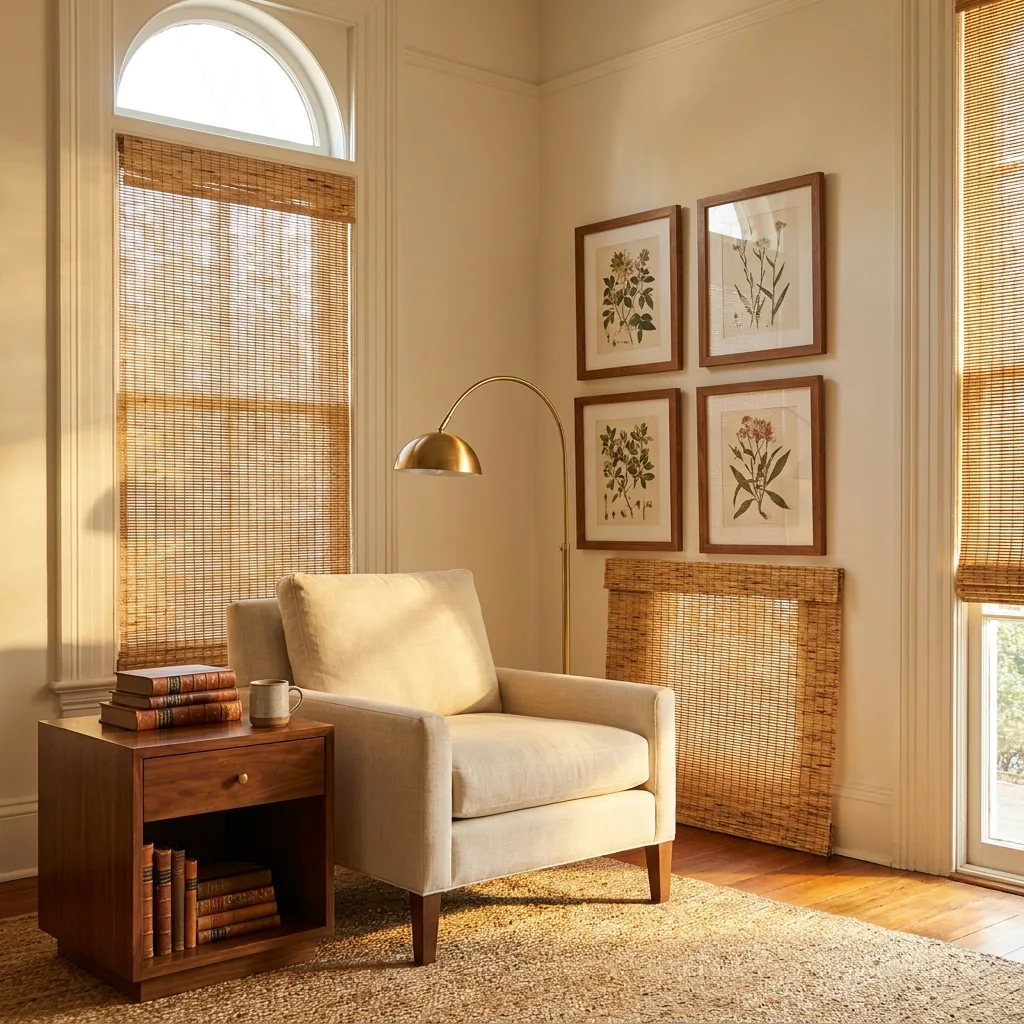
Without a liner, woven woods are light-filtering — they soften and warm direct sun into a glow with horizontal shadow lines from the weave. This is the most beautiful single feature of the category. Sunset through a woven wood is the reason people install them.
With a liner, you can add:
- Privacy liner — neutral fabric on the back, blocks the silhouette while preserving the natural look from inside.
- Room-darkening liner — substantial light reduction, right for guest bedrooms.
- Blackout liner — full darkness, right for primary bedrooms. Pairs the warm natural face with full blackout function.
Roll styles
- Roman fold — fabric gathers into horizontal pleats when raised. The classic look.
- Waterfall — fabric stacks neatly behind itself, no gather at the bottom. Cleaner, more modern.
- Front-slat — bottom rail visible, stack folds behind. Less common, more architectural.
Where woven woods belong
- Sitting rooms and living rooms with warm wood floors and brass or leather accents.
- Dining rooms — the texture pairs beautifully with linen drapery.
- Bedrooms (with blackout liner) — the warmest blackout treatment in the catalogue.
- Sunrooms and screened porches with interior glass.
- Arched windows — woven woods on arched windows are spectacular when templated correctly.
- Children's rooms — naturally cordless, soft, calming.
Where they don't
- Very humid rooms (bathrooms, laundry). Natural fiber + moisture = trouble.
- Hard-modern interiors with high-contrast finishes — woven woods often clash.
- Direct ocean/lake spray — even with marine treatment, natural fibers don't love salt.
A woven wood is the rare shade that you'd want to look at even with no window behind it.
The lines we install most
- Hunter Douglas Provenance. The premium standard — exceptional weaves, top-down/bottom-up rigs, PowerView motorization, the broadest fabric library in the category.
- Graber Naturals. Excellent value, broad material range, cordless or motorized.
- Pacific Woven (boutique). Hand-loomed in California, for clients who want a known-provenance natural.
Motorization
Hunter Douglas Provenance runs on PowerView Gen 3. The motor handles the weight of natural materials beautifully — woven woods are heavier than cellular fabrics, and the Provenance motor is sized accordingly. We motorize about half of the woven wood projects we quote, because most of these shades end up on tall windows in great rooms or stairwells where reach matters.
Cost
- Standard woven wood, cordless, light-filtering: $220–$520 per window installed
- Premium Provenance, cordless: $340–$780 per window installed
- With blackout liner: add $80–$160 per window
- Top-down/bottom-up: add ~15%
- Motorization (Provenance PowerView): add $180–$360 per window
For an in-home consultation with full bamboo, grass, jute, and reed samples — held to your window in your own light — call or text 629-298-8241 or book a free visit.