Motorized blinds are no longer a luxury upgrade — they are the most-requested feature in every consultation we've done this year. Battery life is finally long enough to matter, hubs are finally small enough to disappear, and voice integration with Alexa, Google Home, and Apple HomeKit has gone from clunky to genuinely good. If you are planning new construction, a renovation, or a primary-bedroom refresh in 2026, motorization is at least worth a conversation.
Here is everything we tell clients before they sign — products, integrations, what to expect on install day, and the three rooms where motorized blinds are almost always worth the cost.
The two systems we install most
Hunter Douglas PowerView Gen 3
The premium answer. PowerView Gen 3 (released 2023, dramatically more responsive than Gen 2) drives every motorized Hunter Douglas treatment — Silhouette, Pirouette, Luminette, Duette, Provenance, Designer Roller, and the full plantation shutter tilt line. The mobile app is good, the hub is unobtrusive, and the integrations are first-party with Alexa, Google Home, Apple HomeKit, and SmartThings.
Best for: homes built around premium fabric treatments (Silhouette, Pirouette, Luminette), and any project where the client wants one system end-to-end.
Somfy
The professional answer. Somfy is the motor that lives inside a vast amount of "house-brand" motorized treatments — including most of what we sell from Norman, Graber, and Sol-Lux outdoor. Their TaHoma hub controls shades and integrates with Alexa, Google Home, HomeKit, and most security systems. Somfy motors are widely considered the most reliable in the industry; we have ones in the field still running on the original install from 2008.
Best for: large homes, outdoor systems, and any project where you want the option to keep the same motor brand across different shade manufacturers.
Both systems are excellent. The choice between them usually comes down to which treatments you want most — if you fall in love with Silhouettes, you are getting PowerView. If your project is heavy on outdoor screens and plantation work, you are probably getting Somfy.
Battery, hardwired, or solar?
The motor has to be powered. There are three ways to do it, and the choice shapes both the install cost and the long-term maintenance.
Battery (the retrofit choice)
Rechargeable lithium battery wands clip to the headrail. Charge by USB-C every 12–36 months, depending on use. Pros: No wall work, no electrician, retrofits anywhere. Cons: Eventually needs charging — and on a tall shade, that means a ladder.
Best for: existing homes, single-room upgrades, and any project where opening a wall is out of scope.
Hardwired (the new-construction choice)
Low-voltage wiring run from a transformer to each shade. Set it and forget it forever. Pros: No batteries, instant response, supports the heaviest treatments (drapery, outdoor screens). Cons: Has to happen during the framing or drywall stage.
Best for: new construction, gut remodels, and any room with five or more motorized shades.
Solar (the underused option)
A small solar panel on the window frame charges the battery indefinitely. Works beautifully on south-facing windows. Pros: True install-and-forget. Cons: Solar panel is visible on the casing, and won't fully charge a heavily-used motor on a north-facing window.
Best for: tall windows above stairwells, sunrooms, atriums.
What we usually recommend
For most existing homes: battery. For new construction: hardwired. For tall stairwell windows you'd rather never touch again: solar.
Voice control and scenes
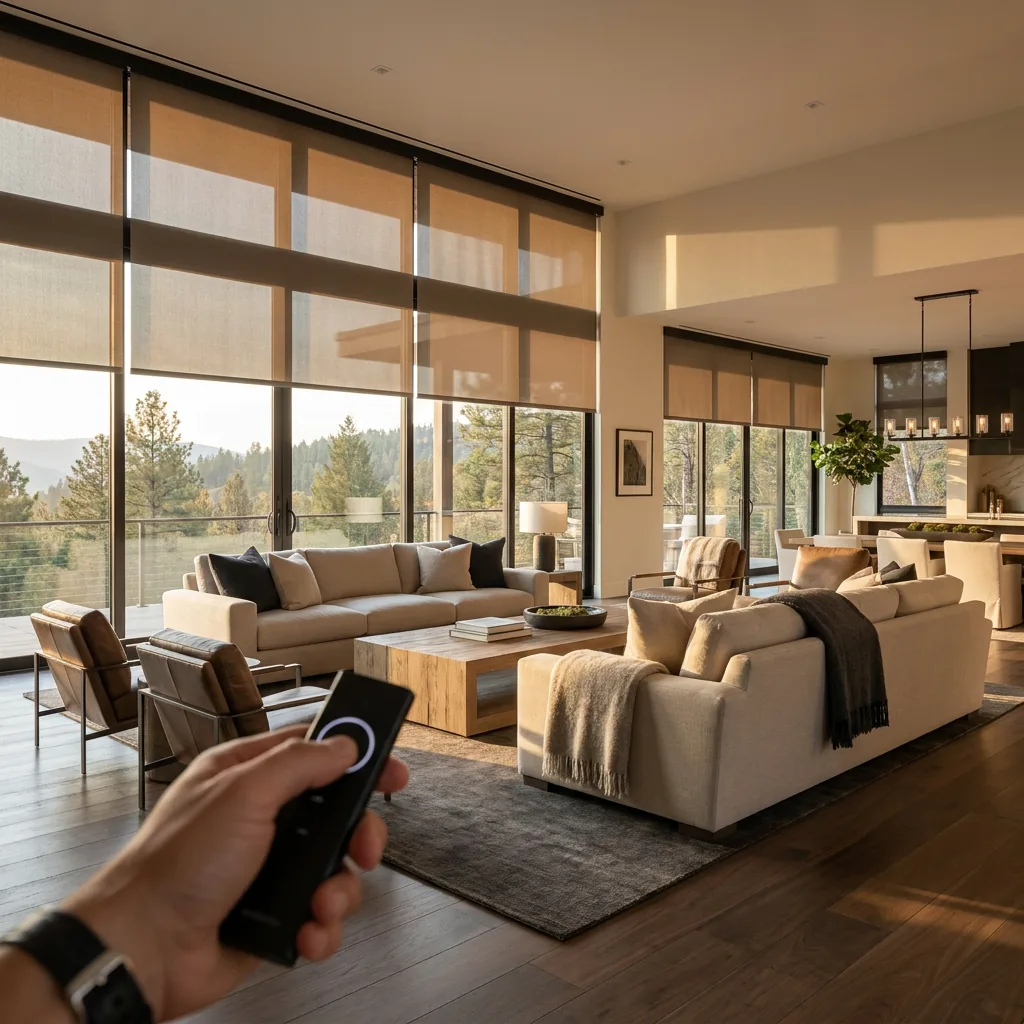
The feature clients fall in love with isn't the voice command — it's the scene. A scene is a single command that moves multiple shades to specific positions at the same time.
The scenes we set up in nearly every motorization project:
- Good Morning. All blackout shades in the primary suite raise gradually starting at the homeowner's wake-up time. We typically set a 90-second open so the room brightens, rather than jolts.
- Good Night. Every shade in the house goes down at a single voice command. Privacy, security, and energy savings in one tap.
- Movie. Family room shades drop to full blackout, hallway shades drop halfway, kitchen stays up.
- Sun Block. A sun-tracking scene that lowers solar shades on the southwest face of the house during the worst summer sun, then raises them back at 6 p.m.
- Welcome Home. Geofence-triggered — when the homeowner's phone enters the driveway, the front-facing shades open partway.
The voice command is a party trick. The scene is what changes how you live with the windows.
What does it cost?
Motorization adds a premium on top of the base shade. As of 2026:
- Motorized rollers: from $320/window installed
- Motorized cellular (Duette, Sonnette, Honeycomb): from $380/window installed
- Motorized Silhouette, Pirouette, Luminette: from $600/window installed
- Motorized plantation shutter tilt: from $700/window installed
- PowerView or TaHoma hub (one per house): $150–$300, one-time
- Hardwired transformer + electrician work: $400–$1,200 for a typical room
A typical "smart house" motorization across a primary suite, great room, and kitchen lands between $5,000 and $15,000 installed, including hub.
The three rooms where it's almost always worth it
1. Primary bedroom
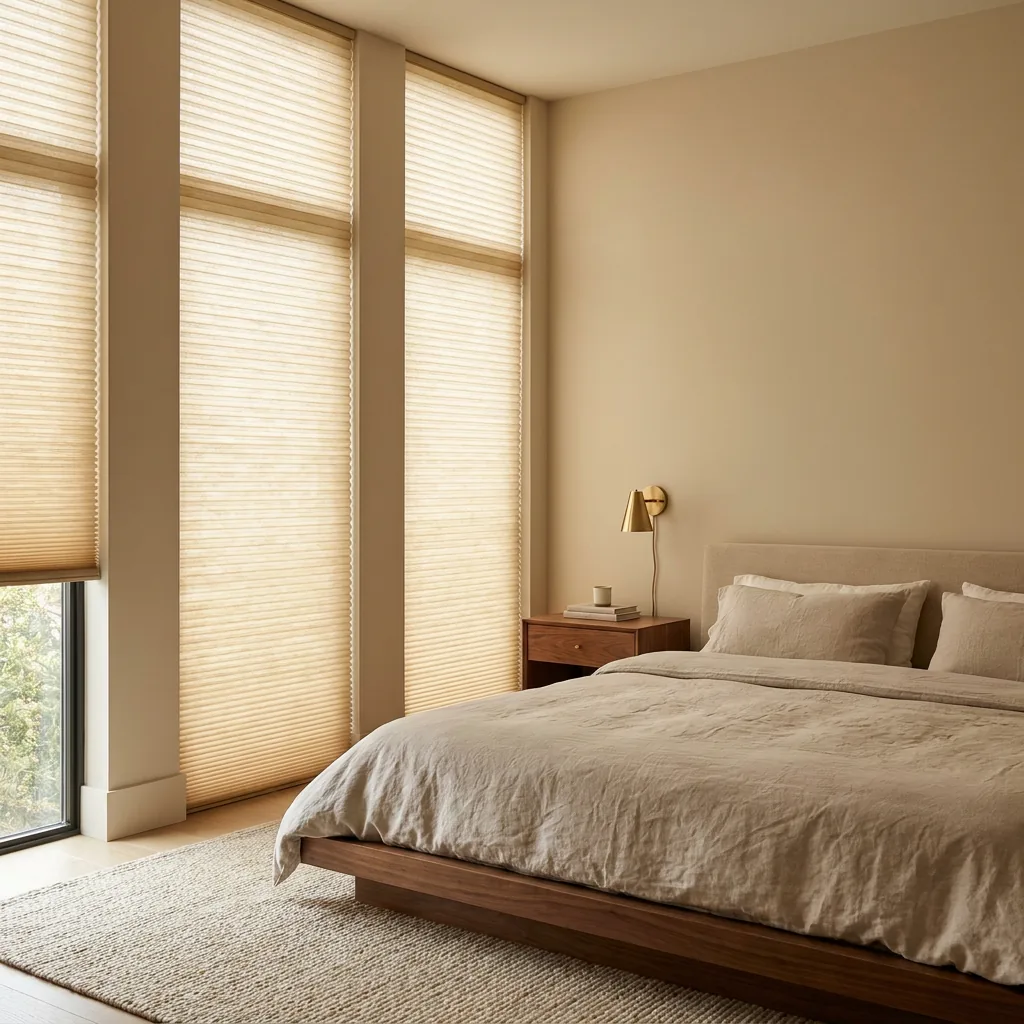
Wake-up scenes alone justify the cost. Every primary-bedroom motorization we've installed has come back as the favorite feature in the house at the one-year follow-up.
2. Great rooms with three or more windows
The math: three manual shades, raised and lowered twice a day, takes about 90 seconds. Motorize them, and it's one tap. Over a year that's an hour of your life back. Over the life of the house, that's the whole install paid for in time saved.
3. Anywhere you can't reach
Vaulted-ceiling transoms, atrium walls, stairwell glass, the high east-facing window above the kitchen sink. The single best argument for motorization isn't laziness, it's that you'll actually use the shade you can't reach.
Things to know before you sign
- The motor is silent on premium lines. If you're shown a demo where the motor whirrs noticeably, ask for the next tier up. Top-tier PowerView and Somfy motors are nearly inaudible.
- Plan the hub location. One hub controls the whole house, but it needs power and Wi-Fi. We pick a central spot during the consultation.
- Test integrations before you commit. If you live in Alexa, make sure the model we quote works with Alexa. (All current PowerView and TaHoma do.)
- Warranties. Hunter Douglas covers PowerView motors for 5 years. Somfy covers motors for 5 years on residential, 7 on commercial. Both are best-in-class.
For a custom motorization plan — site-walked, hub-located, every line item shown — call or text 629-298-8241 or book a free in-home consultation. We cover Gallatin, Nashville, Hendersonville, Franklin, Brentwood, Murfreesboro and the 90-mile radius around Gallatin.